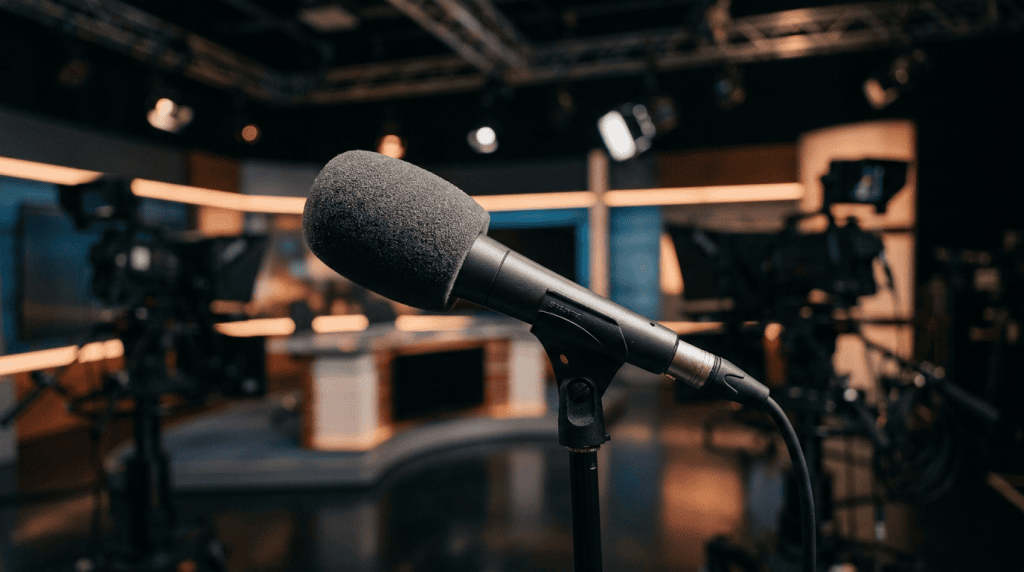
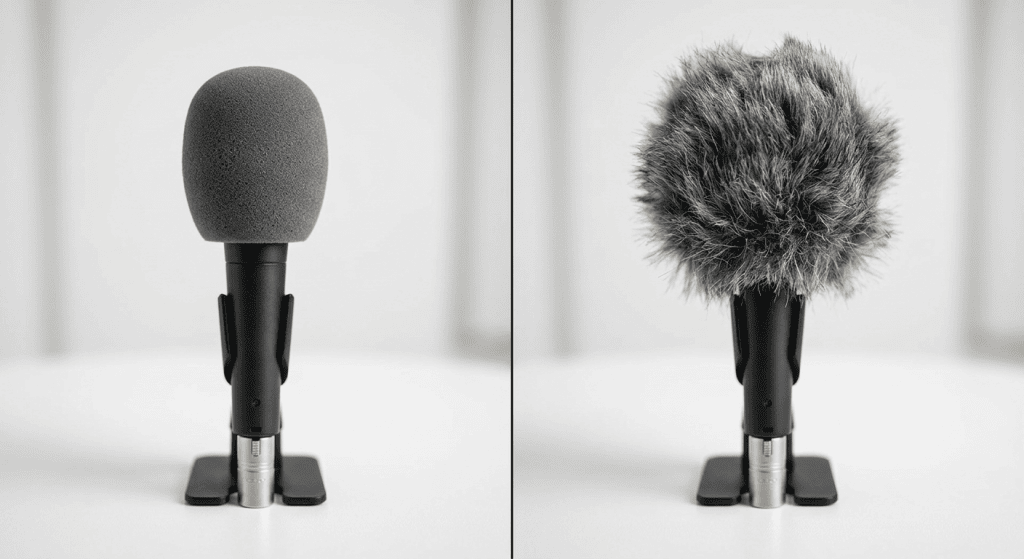
Standard foam microphone windshields form the broadest segment of the wind protection market. They cover the majority of microphone types in professional environments, provide functional acoustic protection in indoor and light outdoor conditions, and serve as the baseline specification for any production requiring wind and plosive control without the complexity of a custom or field-grade system.
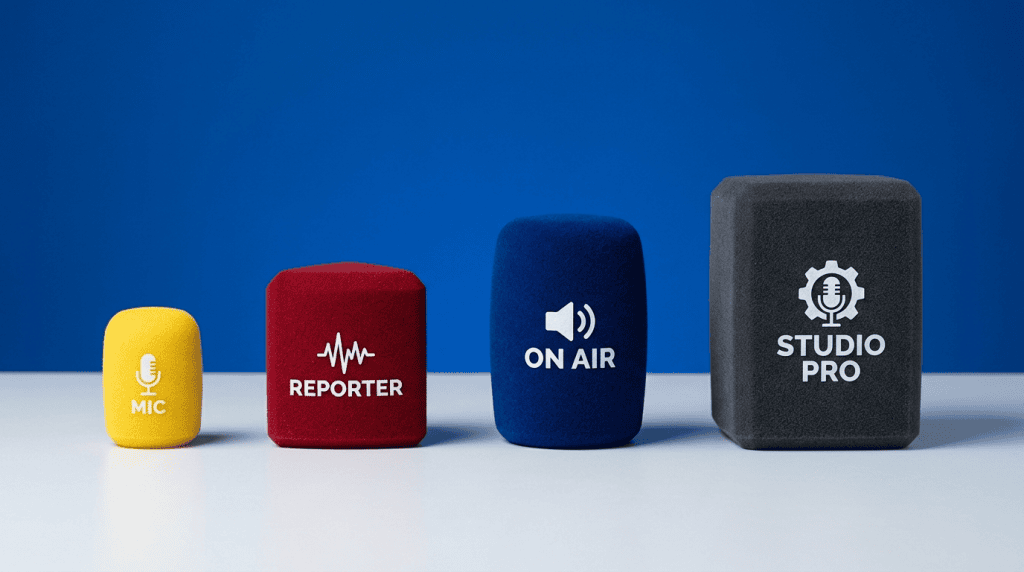
Table of Contents
What standard windshields do
A standard foam windshield attenuates wind noise and turbulence before they reach the microphone capsule, and reduces plosive energy in close-microphone speech applications. In indoor environments — studios, radio booths, meeting rooms, controlled interview spaces — foam windshields are typically sufficient for all practical acoustic requirements.
The limits of standard foam outdoors are well-documented. Beyond light breeze, more advanced protection becomes necessary — fur covers, zeppelin assemblies. The transition point is covered in the articles on foam windscreen outdoor use limits and foam vs fur windscreen selection.
Compatibility: how windshields are sized
Standard foam windshields are sized by internal diameter, which must match the external barrel diameter of the microphone. Common barrel diameters range from approximately 18mm for compact condensers to 40mm or more for large-diaphragm studio microphones. Handheld broadcast microphones typically have a barrel diameter in the 33–34mm range.
When selecting by diameter rather than by model, measure the barrel at the point where the windshield will sit — not at the widest point of the body. Many microphones taper toward the capsule end, and the windshield must seat at the correct position to be acoustically effective.
Product families within the standard range
The full windshield range covers several distinct product families, each optimised for a specific microphone geometry.
Mini Windcovers address compact microphone formats — on-camera microphones and narrower barrel profiles. Mini-ALTO Windshields cover a mid-range profile suited to a broad set of broadcast and production microphones. Nimbus Windshields address larger format barrels. For lavalier microphones, Urchin Lavalier Windshields provide purpose-built protection scaled to the small capsule dimensions of this microphone class.
Branded and unbranded variants
Unbranded windshields provide acoustic protection in a standard colour selection — black, grey, and white — without logo application. The standard branded tier, available through the branded windshields with logo range, adds logo application to a predefined windshield format. Unlike the professional custom tier, standard branded windshields do not offer shape customisation or Pantone colour matching.
The distinction between standard and professional branded windshields is covered in the wind protection selection guide.
Selection in practice
For most standard windshield selections, the process reduces to three steps: identify the microphone model or barrel diameter, confirm the primary use environment, and decide whether branding is part of the specification. Where the use environment involves significant outdoor exposure, the selection should move toward fur-covered options or field protection systems rather than standard foam.
Standard Microphone Windshield Compatibility: FAQ
How do I know what size windshield fits my microphone?
Measure the external barrel diameter at the point where the windshield will sit, in millimetres. Match this measurement to the internal diameter range specified for the windshield. Many windshields are also indexed by specific microphone models — check the product compatibility listing if your microphone is a common broadcast model.
What is the difference between unbranded and standard branded windshields?
Unbranded windshields have no logo and are available in standard colours. Standard branded windshields include logo application on a predefined windshield geometry in a limited colour set. Neither offers the custom shapes or Pantone colour matching available in the professional tier.
Can a standard foam windshield be used outdoors?
In light wind conditions, yes. Standard foam provides adequate attenuation for low wind speeds and is appropriate for outdoor use in sheltered or calm environments. For regular outdoor work in variable weather, a fur-covered windshield or full zeppelin system is the correct specification.
What is the difference between Mini Windcovers, Mini-ALTO, and Nimbus formats?
These product families cover different barrel diameter ranges. Mini Windcovers fit compact and narrow-barrelled microphones. Mini-ALTO covers the mid-range broadcast microphone profile. Nimbus addresses larger barrel diameters. Each family is optimised for the physical geometry of the microphone types it serves