Selecting the right microphone wind protection is not a matter of picking the nearest available foam cover. The type of windshield, its material, shape, and construction all affect both acoustic performance and visual function — and the wrong choice shows up quickly in production, whether as degraded audio or an unprofessional on-camera appearance.
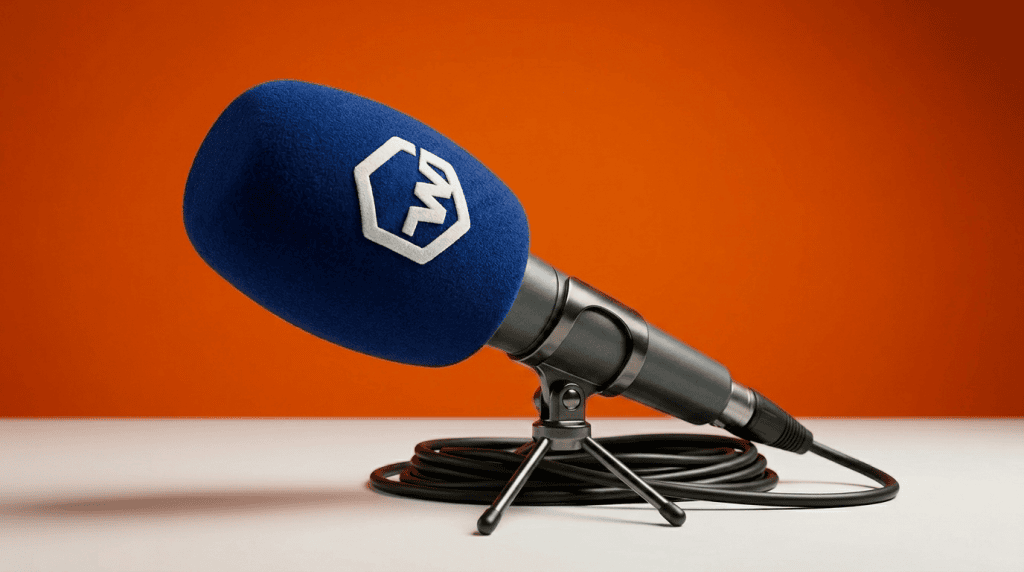
This guide ‘How to Choose Microphone Wind Protection’ covers the four core factors that determine the appropriate wind protection for any professional scenario: recording environment, microphone type, acoustic requirements, and branding context.
Table of Contents
Environment: the primary determining factor
The recording environment drives every other decision. A studio-mounted microphone faces virtually no wind load — plosive control and speech clarity are the only acoustic priorities. A microphone used for outdoor ENG work operates under entirely different conditions, where gusts, turbulence, and movement can render a basic foam windscreen insufficient within seconds.
Indoor environments — studios, radio booths, podcast rooms, press conference spaces — are well served by standard foam microphone windshields. Open-cell acoustic foam attenuates plosive energy and breath noise without altering voice character or adding mechanical complexity to the setup.
Outdoor environments require a layered approach. Foam alone has physical limits beyond light breeze conditions, as covered in the article on foam windscreen outdoor use and its limits. In moderate to high wind, synthetic fur covers (deadcats) are the practical standard. In extreme conditions or professional ENG work, full blimp/zeppelin systems with internal suspension are the correct solution.
Microphone type and form factor
Wind protection must match the physical geometry of the microphone. Handheld broadcast microphones take a different windshield than a studio condenser on a boom arm, which in turn differs from a lavalier clipped to a lapel or a shotgun microphone on a film set.
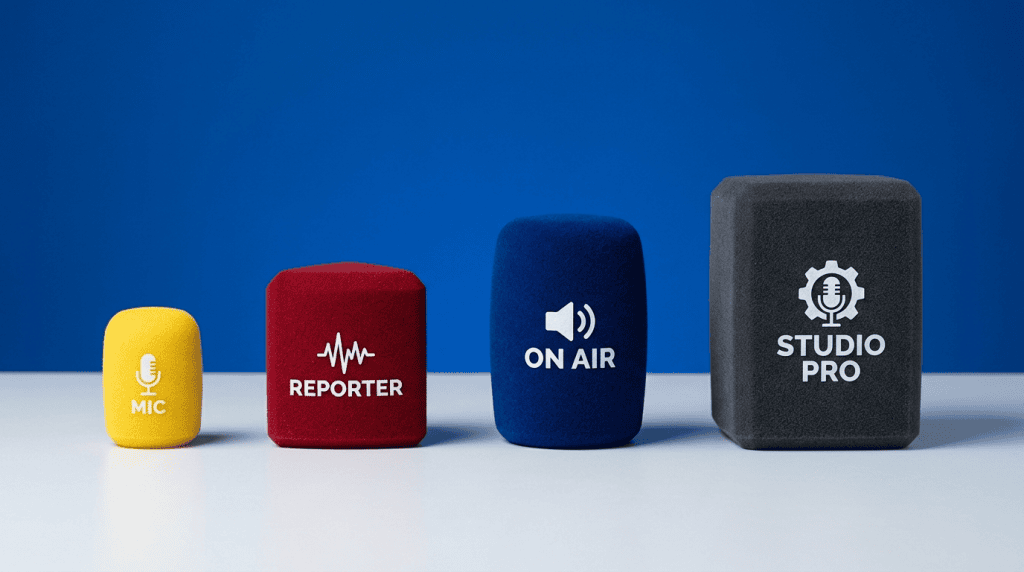
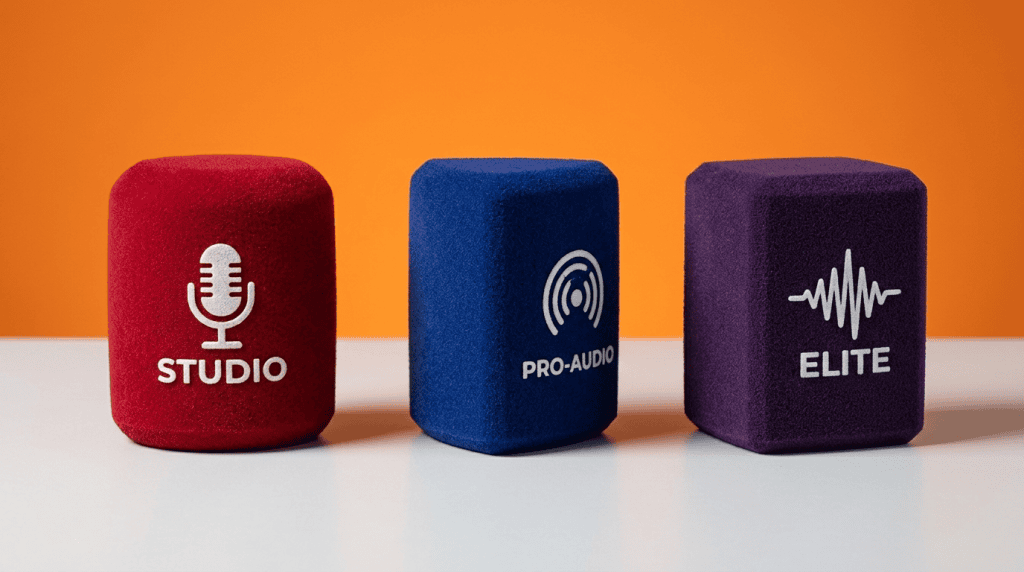
For handheld broadcast microphones, cylindrical and multi-sided foam windshields are the standard formats. Three-sided and four-sided windshields are specifically designed for interview use, where flat faces provide defined branding surfaces visible from multiple camera angles. The full breakdown of shape options — including custom geometries for wireless transmitter systems — is covered in the windshield shape selection guide.
Acoustic requirements
Plosive control — managing the burst of pressure from consonants such as “p” and “b” — is the primary concern in close-mic speech applications. Open-cell foam windshields address this well in controlled indoor environments.
Wind noise reduction outdoors is a different problem. Moving air creates pressure fluctuations across the entire diaphragm, generating low-frequency rumble that foam only partially attenuates. Fur covers add a second attenuation stage by trapping and slowing moving air before it contacts the foam. Understanding when foam is enough and when fur is required is one of the more consequential decisions in location audio.
Broadcast and branding requirements
In broadcast television, radio, and media production, the microphone windshield is a visible element in the production frame. Branded windshields are produced in two tiers: professional-grade custom windshields manufactured by Foam Conversion (UK), offering any Pantone colour and fully custom shapes; and a standard tier with a predefined colour range suited to smaller productions and events.
The Pantone colour matching guide explains why Pantone is the professional standard for foam production. If branding is part of the decision, the logo preparation guide covers contrast, scale, and artwork file requirements.
Budget and production scale
For standard acoustic protection without branding requirements, unbranded foam windshields provide functional coverage at accessible price points. For branded applications, economy comes with volume: custom windshields are more cost-effective per unit at higher quantities. Professional field systems — blimp assemblies, fur windcovers, shock mounts — represent capital investment justified by regular location recording work.
Summary
Choosing the right microphone wind protection requires honest assessment of the environment, the microphone form factor, whether branding is part of the function, and the budget context. The subsequent articles in this cluster address each factor in detail: shape selection, logo preparation, colour matching, and standard windshield compatibility.
How to Choose Microphone Wind Protection: FAQ
What is the difference between a foam windshield and a deadcat?
A foam windshield uses open-cell acoustic foam to attenuate plosive energy and light wind. A deadcat adds a layer of synthetic fur over the foam, trapping moving air before it reaches the foam surface. Foam is sufficient for indoor and light outdoor use; deadcats are required in moderate to strong wind conditions.
Can the same windshield be used indoors and outdoors?
A foam windshield can be used in both environments, but its outdoor performance is limited to light wind conditions. For reliable outdoor use in variable weather, a fur-covered windshield or a full blimp/zeppelin system is the correct specification.
Does windshield shape affect sound quality?
Shape primarily affects branding surface area and on-camera appearance, not acoustic performance. All standard foam geometries — cylindrical, three-sided, four-sided — provide equivalent acoustic function for their intended microphone types. The foam material and fit are the acoustically significant variables.
How do I know which windshield fits my microphone?
The primary compatibility parameter is the internal diameter of the windshield cavity matched against the external barrel diameter of the microphone. Most windshields are specified by microphone model or by a millimetre diameter range. When in doubt, measure the barrel at the position where the windshield will sit.
Is Pantone colour matching necessary for branded windshields?
For professional broadcast applications where colour consistency and brand accuracy are required, yes. Pantone specifies the exact pigment formulation used in the foam material, which means the colour produced matches the reference precisely. RGB and CMYK references cannot be reliably converted to foam pigment without colour drift.