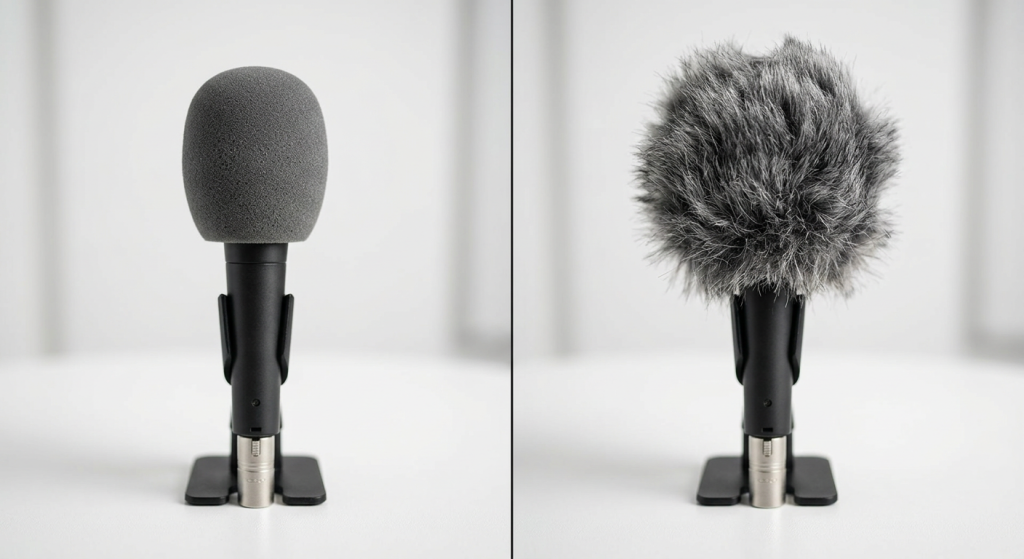
Fur handles more wind than foam. That part most operators know. What catches people out is the assumption that fur scales — that a thicker deadcat on a better shotgun mic will keep working as conditions deteriorate. It does not. At a certain wind level, fur alone stops being a solution, and no upgrade within that category changes the result. The question for a solo operator with a limited kit budget is: where exactly is that line, and how often will your work cross it?
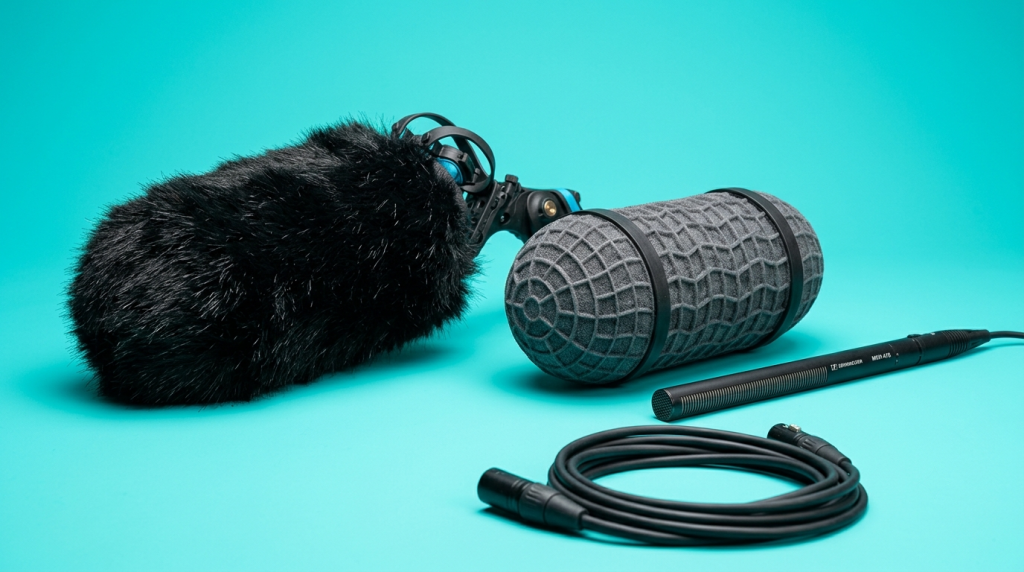
Table of Contents
What Fur Actually Does — and Where It Stops
A fur windscreen works by breaking up turbulent airflow before it reaches the capsule. The fibres create a low-velocity boundary layer around the mic. For a long-barrelled shotgun like an MKH 416 or a Rode NTG3, a well-fitted deadcat extends usable outdoor recording into conditions where foam would have already failed — typically Beaufort 3 to 4, moderate breeze with moving branches and raised dust. That covers a large proportion of ENG and documentary location work.
Above Beaufort 4 — fresh breeze, small trees beginning to sway, around 29–38 km/h — the fur boundary layer gets disrupted faster than it can reform. Low-frequency pressure waves reach the capsule. The result on the recording is a rhythmic low-end disturbance that post-production cannot cleanly remove without affecting the fundamental frequencies of speech. It is not a matter of mic quality or fur density at that point. It is physics.
On open locations — exposed hillsides, coastal shoots, sports sidelines, rooftop interviews — Beaufort 4 is not unusual. It is the baseline. A fur windscreen alone is not the right tool for those environments.
What a Blimp Adds That Fur Cannot
A blimp system — rigid basket, internal suspension, external fur cover — addresses the problem differently. The basket creates an air cavity around the mic. That cavity absorbs pressure fluctuations before they reach the capsule. The internal elastic suspension decouples the mic from handling vibration transmitted through the boom pole. The outer fur then handles the surface turbulence. It is a three-stage system, and each stage does something fur alone cannot replicate.
The internal suspension matters as much as the wind protection in practice. A solo operator hand-holding a boomed mic on a long run generates constant low-level handling noise. On a fur-only setup, that vibration goes directly into the mic body. On a blimp with an internal shock mount, it does not reach the capsule. This is a separate problem from wind, but it shows up in the same recording environments. The EBU’s technical guidelines for location audio consistently treat mechanical isolation and wind protection as linked requirements for outdoor production — not independent options.
The Solo Operator’s Budget Decision
A full blimp kit costs more. It takes longer to deploy. It adds weight and bulk to a one-person rig. For a solo operator covering daily news or documentary run-and-gun, those factors are real constraints, not excuses.
The practical framework comes down to three questions:
What wind levels does your work regularly involve?
If the majority of your locations are urban environments — street interviews, building interiors, controlled outdoor setups with natural wind breaks — a quality fur windscreen on a well-chosen shotgun covers most of it. The occasions you hit Beaufort 4+ are infrequent enough that you manage them by repositioning or rescheduling. Fur as primary, blimp as rare rental or borrowed kit makes budget sense.
How exposed are your regular locations?
Coastal, rural, stadium, or rooftop work changes the calculation entirely. If you are regularly working locations where moderate-to-fresh wind is the norm rather than the exception, building a kit around fur alone means you will regularly return with compromised audio. A blimp system here is not an upgrade — it is the correct baseline tool. You can find a practical overview of deadcat and fur options to understand what fur does well before committing to a blimp investment.
What is your mic?
Short cardioids and hypercardioids — including interview mics like the Sennheiser MD 46 used handheld — are less exposed to wind than a long shotgun on an extended boom. A hyper on a short pole in moderate wind behaves differently than an NTG5 at full boom extension. Fur works further up the wind scale on a shorter mic. For boom-mounted shotguns in outdoor dialogue recording, the capsule exposure is greater and the argument for a blimp arrives sooner. If you are deciding whether your boom needs fur at all, see whether a deadcat is necessary for your shotgun mic setup. If you are using a blimp system, also consider whether your outer fur cover is in good condition — a matted or degraded cover degrades the system’s performance even if the basket is fine.
When You Actually Need Both
The scenario where both come into play is unpredictable mixed-location work. A day that starts with an interior interview, moves to a sheltered courtyard, and ends with a rooftop sequence is not unusual in documentary production. Carrying a fur-covered shotgun and having a blimp shell available — even collapsed in the bag — gives you the flexibility to respond to what the day delivers rather than compromising when conditions change.
This is not about redundancy for its own sake. It is about having a system that matches the actual range of environments rather than the average.
The Honest Recommendation
For solo operators whose work is predominantly urban or controlled-outdoor, a high-quality fur windscreen is the right primary investment. Buy the blimp when exposed locations become a regular part of your schedule — not before. For those already working open-air locations consistently, the blimp is not optional equipment. Start there, and use the fur cover as your first line of defence within the system, not as a standalone solution.
FAQ
Can I use a fur windscreen over a blimp?
Yes — and most blimp systems are designed for exactly this. The external fur handles surface turbulence, the basket cavity absorbs pressure fluctuations, and the internal suspension manages handling noise. Removing the fur cover from a blimp in high wind significantly reduces the system’s effectiveness.
At what wind speed does fur windscreen protection fail?
On a boom-mounted shotgun, a fur windscreen typically starts to show limits around Beaufort 4 — fresh breeze, approximately 29–38 km/h. This varies by mic diameter, fur density, and boom angle relative to wind direction, but Beaufort 4 is a reasonable field threshold.
Is a blimp necessary for indoor recording?
Not for wind protection. Indoors, a blimp’s value comes from the internal shock mount, which isolates the mic from boom and handling vibration. For dialogue recording on a long boom, that isolation is worth having regardless of weather.
Does mic brand affect how well fur windscreen protection works?
Mic brand does not. Capsule diameter, housing length, and positioning relative to wind direction affect results. A longer shotgun housing creates more surface area exposed to airflow — fur has more work to do on a 250mm shotgun than on a compact hypercardioid.