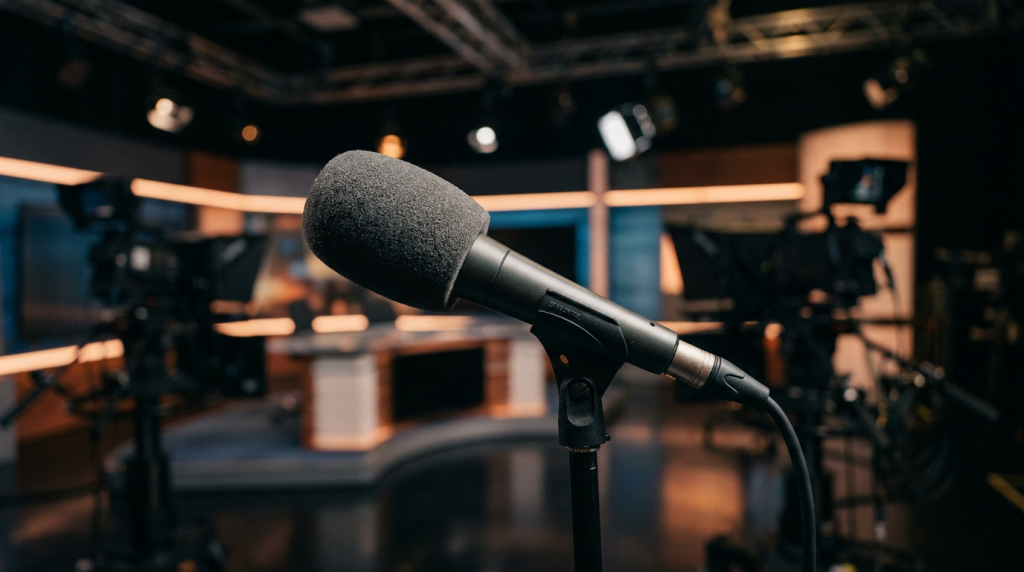
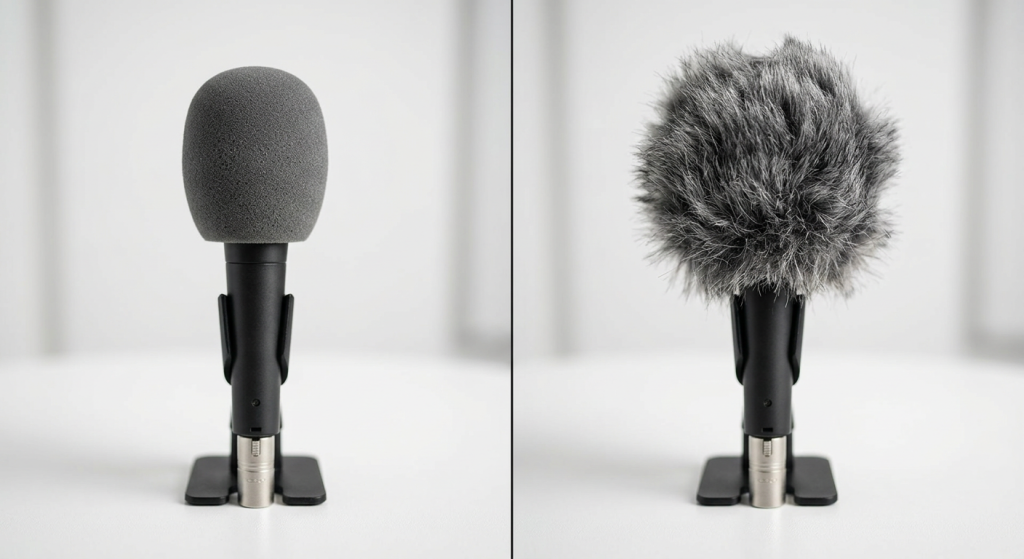
Foam fails in wind earlier than most operators expect. Not in a storm — in ordinary autumn breeze on a city street, in the wind shadow of a building that suddenly opens up, in the draft created by a subject walking fast toward a static camera. A standard foam windscreen on a Sennheiser MKH 416 or Rode NTG3 begins to show low-frequency rumble at Beaufort 2–3. That is a gentle breeze. It is not exceptional weather. It is most exterior locations on most shooting days.
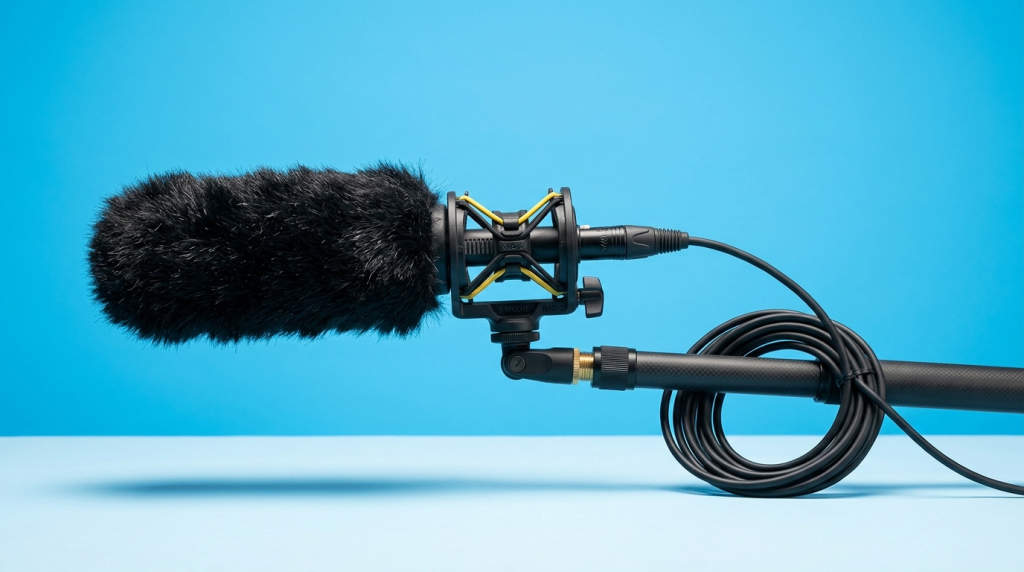
Table of Contents
Why Boom Operation Changes the Equation
Camera-mounted shotguns operate in relatively still air. The camera is locked or moving slowly, and the mic sits close to the body of the rig where airflow is disrupted by the operator. A boom mic works differently. It is extended on a pole, often over a subject’s head, moving through space as the operator follows action. Even a slow pan creates relative airflow across the capsule. Even standing still in light wind, the exposed position of a boomed mic means it sees more air movement than a camera-mount in the same location.
The supercardioid and hypercardioid polar patterns used in most documentary shotguns — the MKH 416, the Schoeps CMIT 5U, the Deity S-Mic 2 — add another factor. Their tight off-axis rejection is a feature in controlled environments. Outdoors, when wind strikes the rear and sides of the mic, those lobes can pick up turbulence in ways that a broader cardioid would not. Fur addresses this. Foam does not, at any meaningful wind level.
What Foam Actually Protects Against
This is not about foam being low quality. Foam works well for what it was designed to handle: studio breath noise, light handling vibration, and incidental air movement from HVAC or a subject gesturing close to the mic. It also protects the capsule from dust and moisture during transport. For a documentary boom that never leaves an interior — a courtroom, a rehearsal space, an office — foam is sufficient. In those environments, adding fur introduces bulk and changes the mic’s visual profile without offering any acoustic benefit.
The problem is that documentary work rarely stays inside. And the transition from interior to exterior, or from sheltered exterior to exposed exterior, can happen mid-scene. A fur windscreen — a proper dead cat for shotgun mic use — handles Beaufort 3–4 reliably and extends workable range into Beaufort 5 conditions, depending on the specific design and the mic’s sensitivity. That covers most real-world location scenarios short of severe weather.
The Real Decision on Set
The practical question is not “foam or fur in general” — it is “what do I put on the boom before this day’s shoot”.
If the call sheet shows a single interior location with climate control, foam is the right choice. Lighter rig, no visual distraction if the mic dips into frame, less interference with the mic’s high-frequency response.
If there is any exterior work — even a brief walk-and-talk between buildings, a doorstep interview, a tracking shot in a car park — bring the fur. Not as a backup. On the boom from the start. Switching windscreens mid-shoot while an interview subject is waiting is a workflow problem that fur prevents entirely.
The scenario where operators get caught out is the interior location with opening doors, loading bays, or large windows. Air movement in these spaces can be unpredictable and can spike fast. A Beaufort 3 gust through an open warehouse door creates the same problem on the recording as it would outside. The rumble it introduces — typically below 100 Hz and often extending up to 200 Hz — is the kind that broadband noise reduction cannot remove without audible damage to the voice. Low-cut filtering at 80 or 100 Hz helps, but it is a compromise, not a fix.
Fur Weight, Mic Balance, and Boom Fatigue
One honest limitation of fur windscreens on long booms: weight and wind resistance add up over a full shooting day. A deadcat on an MKH 416 on a 3-metre carbon pole is manageable. The same setup with a heavier fur on a fibreglass pole for six hours of continuous boom operation is a different proposition. Operators working long documentary shoots in genuinely exposed conditions sometimes move to a blimp — a suspension system with an interior foam and outer fur — which provides better isolation and superior wind rejection, at the cost of more bulk and slower repositioning. For most documentary boom work that is not the right trade-off, but it is worth knowing the ceiling of what fur alone achieves. The fur vs blimp decision has its own logic for longer-form exterior shooting.
Recommendation
For documentary boom operation with any exterior component, a dead cat for shotgun mic is not optional equipment — it is the standard starting point. Foam is a valid choice only for confirmed interior-only shoots. If there is any doubt about the environment, the fur goes on before the day starts. The recording cost of getting this wrong in post is always higher than the minute it takes to fit the windscreen correctly.
FAQ
Can I use foam on a shotgun mic for indoor documentary work?
Yes. For controlled interiors without significant air movement from HVAC, doors, or open spaces, foam provides adequate protection and keeps the rig lighter. Reserve fur for any situation involving exterior exposure or unpredictable airflow.
Does a deadcat affect the high-frequency response of a shotgun mic?
A well-designed fur windscreen introduces minor high-frequency attenuation — typically above 10–12 kHz — which is acceptable in most dialogue recording. Poorly fitted or excessively dense fur can cause more noticeable roll-off. For music recording or sound effects capture where top-end accuracy matters, a blimp system (rigid basket with internal shock mount and outer fur cover) offers more controlled acoustic transparency.
How do I know what size deadcat fits my shotgun mic?
Match the internal diameter of the windscreen to your mic’s body diameter. Most standard ENG shotguns like the MKH 416 and NTG3 use a 19–21mm body. Check the specific internal diameter listed by the windscreen manufacturer against your mic’s published dimensions before ordering.
How often should a fur windscreen be cleaned?
After any shoot involving rain, dust, or salt air. In normal use, inspect before each production day. Matted or compressed fur reduces wind rejection performance measurably — the fibres need to remain open to dissipate turbulence effectively.