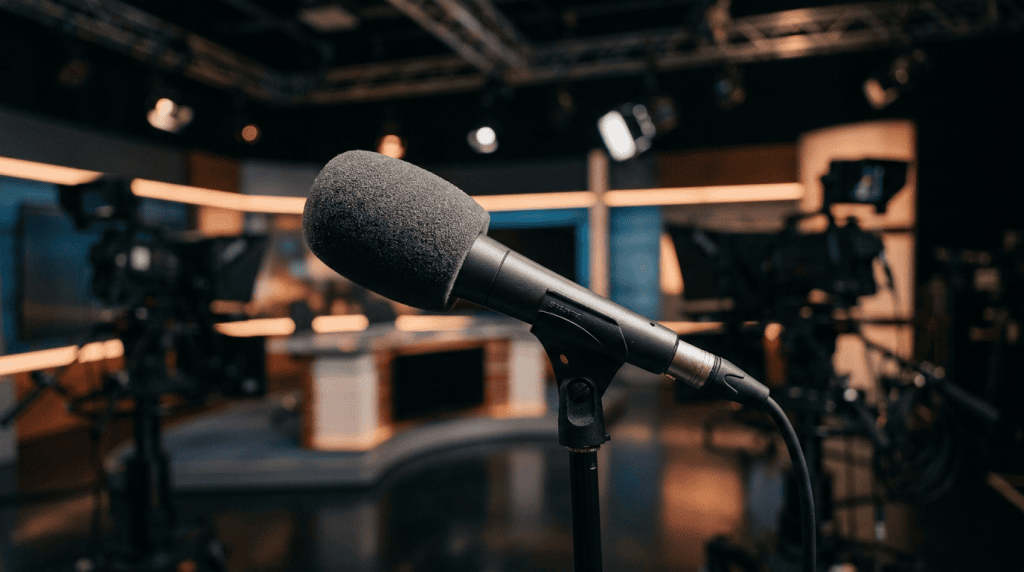
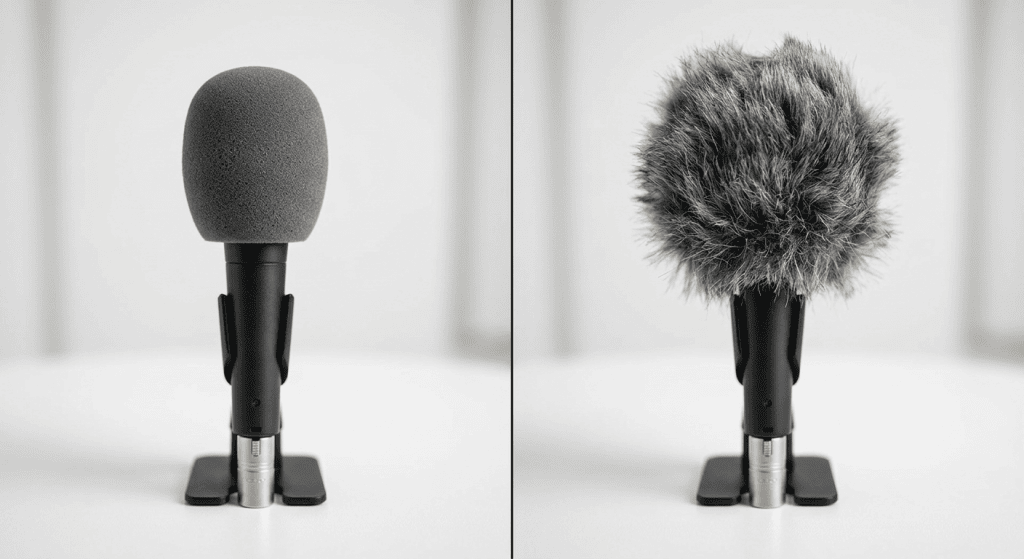
Foam windscreens are widely associated with studio and indoor use, but foam windscreen outdoor use is extremely common in professional broadcast — and in the majority of real-world conditions, quality foam performs the job well. Understanding exactly where foam works outdoors and where it starts to struggle is essential for any audio professional who needs clean recordings without reaching for heavier equipment unnecessarily.

The honest answer is that foam covers a wider range of outdoor conditions than many people assume — but it does have clear limits, and exceeding those limits in critical recording situations is a mistake that can ruin a take.
4 Factors That Determine Foam Windscreen Performance Outdoors
1. Wind speed
This is the most direct variable. Open-cell foam typically provides between 10 and 20 dB of wind noise attenuation depending on foam density, pore size and thickness. At low to moderate wind speeds — broadly corresponding to what you might describe as a light breeze to a moderate breeze — a good quality foam windscreen handles wind noise cleanly.
As wind speed increases toward what would be described as a fresh or strong breeze, foam begins to show its limits. The turbulence arriving at the microphone capsule is too energetic for the foam to fully dissipate, and low-frequency wind noise starts to contaminate the recording.
For reference, the Beaufort scale defines a light breeze at around 6–11 km/h and a moderate breeze at 20–29 km/h. Quality foam is reliable up to roughly light breeze conditions for critical recordings, and can often manage moderate conditions if other factors are favourable.
2. Foam quality and design
Not all foam windscreens are equal. The acoustic and wind-protection performance of foam depends directly on the cell structure, density and thickness of the material. Professional broadcast-grade foam — such as that used in the Foam Conversion product range available through line-in.eu — is engineered to specific tolerances for pore size and density that balance wind attenuation against acoustic transparency.
Generic or low-cost foam windscreens often use material with less careful pore engineering. This can mean either worse wind protection (too coarse), worse acoustic transparency (too fine), or both in different frequency ranges. Investing in quality foam is not a luxury in professional broadcast — it is part of getting the audio right.
A thicker foam windscreen generally offers better wind protection than a thinner one, at the cost of a slight increase in high-frequency attenuation. For outdoor use, slightly thicker foam profiles are preferred where the design allows.
3. Microphone placement and technique
Foam windscreen outdoor use does not happen in a vacuum. The person holding the microphone, or the position of a fixed mic, has a significant effect on how much wind exposure the capsule receives.
For handheld interview microphones, keeping the mic slightly angled away from the prevailing wind, using the body of the presenter or reporter as a wind break, and avoiding raising the mic unnecessarily high all reduce wind exposure. Experienced broadcast journalists develop an instinct for this positioning without thinking about it consciously.
For fixed or boom-mounted microphones, angle of incidence matters. A microphone pointed directly into the wind receives significantly more turbulent pressure than one angled across it. Where possible, positioning the mic axis across the wind rather than into it reduces the demand on the windscreen.
4. Gustiness versus steady wind
Steady moderate wind is easier for foam to manage than gusty wind of the same average speed. A gust causes a rapid, high-energy impact on the microphone that foam has less time to dissipate. Gusty conditions in otherwise moderate wind can push foam windscreens past their effective limit even when the average wind speed would appear manageable.
If you are monitoring outdoor recordings and hearing irregular, explosive low-frequency hits rather than a steady rumble, you are dealing with gusts rather than steady wind. In this situation, upgrading to fur or a combination system is the right call.
Outdoor Scenarios Where Foam Windscreens Perform Well
News interviews in urban environments. Street-level outdoor interviews in cities typically involve light to moderate ambient wind. A quality foam windscreen on a handheld mic, handled correctly by an experienced journalist, produces clean audio in the vast majority of these conditions. This is why foam remains the standard for on-camera interview microphones globally.
Outdoor press conferences. Press conferences held outdoors — in front of buildings, at podiums in open spaces — are often protected to some degree by surrounding structures and are typically covered from a relatively short distance. Foam handles these conditions reliably.
Outdoor studio sets and broadcast positions. Many broadcasters operate outdoor set positions — a rooftop with a city view, a position outside a landmark. These are typically protected positions chosen partly for their manageable wind environment, and foam windscreens perform well.
Event coverage at venues. Sports events, cultural festivals and political events typically take place at structured venues where camera and commentary positions have some wind protection by design. Foam is the standard for on-camera microphones in these settings.
When to Upgrade from Foam Outdoors
Be ready to switch to fur or a combination system when:
- Wind is audibly strong — you can hear it in your monitoring before you even lift the mic
- You are working in an exposed position with no natural windbreak (clifftops, open moorland, coastal locations)
- Conditions are gusty and unpredictable
- The recording is single-take and failure is not an option
- The microphone is boom-mounted or camera-mounted and cannot be positioned defensively
For on-camera handheld microphones, foam remains the right choice even in moderate outdoor conditions because of its appearance and branding advantages — and because reporter/presenter technique compensates for the wind. For off-camera microphones in genuinely difficult wind, move to fur.
Read more about the full comparison between foam and fur solutions in the main guide: Foam vs Fur Windscreen: How to Choose the Right Wind Protection. For the specific scenarios where a fur windscreen is genuinely necessary, see Dead Cat Windscreen: 5 Situations Where Fur Beats Foam. If you are selecting windscreens for a broadcast operation and need guidance on sizing, How to Choose Mic Windscreen Size: A Practical Sizing Guide is a useful next step.
FAQ
Can I use a foam windscreen outside?
Yes — foam windscreen outdoor use is standard practice in broadcast journalism and event coverage. Quality foam handles light to moderate wind effectively. In strong or gusty wind, a fur or combination system is more appropriate.
What wind speed is too much for foam?
There is no single threshold because foam quality, mic technique and gustiness all affect the outcome. As a rough guide, sustained wind above a moderate breeze (roughly 20+ km/h) with gusts starts to push quality foam toward its limits. Monitor closely and upgrade to fur if wind noise appears on the recording.
Does outdoor use damage foam windscreens?
Foam windscreens are durable in outdoor conditions. They handle rain and dust well. Cleaning with a mild solution and air drying maintains performance. Avoid compressing the foam for extended periods as this can deform the cell structure.
Why do reporters still use foam windscreens outdoors rather than fur?
For camera-facing microphones, appearance and branding are key factors. Foam maintains a professional look on screen and can carry broadcaster logos. Reporters also use mic technique — body position and mic angle — to compensate for moderate wind exposure.
Does foam windscreen thickness matter for outdoor use?
Yes. Thicker foam provides marginally better wind attenuation at the cost of a slight high-frequency reduction. For outdoor-primary microphones, slightly thicker foam profiles are a practical choice where the mic design allows it.