Selecting the right mic windscreen for broadcast is not purely a technical audio decision. It involves audio quality, visual appearance on camera, branding, durability and operational practicality – all of which matter to a professional station running back-to-back programming. Getting it wrong can mean compromised audio on air, inconsistent visual identity, or windscreens that wear out and need replacing far too soon.
This article walks through six practical factors that determine whether a mic windscreen for broadcast works properly for your operation – covering both studio microphones and the field microphones that reporters carry on location.
Table of Contents
6 Factors That Matter When Choosing a Mic Windscreen for Broadcast
1. Acoustic performance in your primary environment
The first question is always: where will this microphone be used most? For a studio microphone used at a desk, the windscreen needs to handle light airflow from air conditioning and the plosive impact of close-mic vocal work. For an outside broadcast handheld, it needs to manage real-world wind in street and event environments.
High-quality open-cell foam meets both requirements effectively. It attenuates plosive energy and light ambient airflow without introducing audible colouration to the recorded voice. This is why foam is the default choice for broadcast microphone windscreens across the industry. The key is foam quality – professional broadcast-grade foam is engineered to specific acoustic tolerances. Generic foam can muffle high frequencies or fail to protect adequately.
For on-camera microphones specifically, no broadcast-standard microphone should go without a foam windscreen. Even in fully controlled studio environments, the windscreen serves multiple functions: acoustic management, physical protection of the grille, and visual identity.
2. On-screen appearance
A mic windscreen for broadcast is, uniquely, a product that appears on camera. Unlike the windscreen on a boom microphone overhead, a reporter’s handheld mic is in shot for most of an interview, an on-screen studio mic is visible throughout a programme, and a presenter’s handheld appears at every outside event.
Foam windscreens suit on-screen broadcast use precisely because they look intentional and professional. A cylindrical foam cover on a handheld microphone is a visual cue that the person holding it is a professional broadcaster – the image is familiar and reassuring to audiences. By contrast, fur windscreens, while effective outdoors, have a “field equipment” aesthetic that looks out of place on a studio set or formal interview.
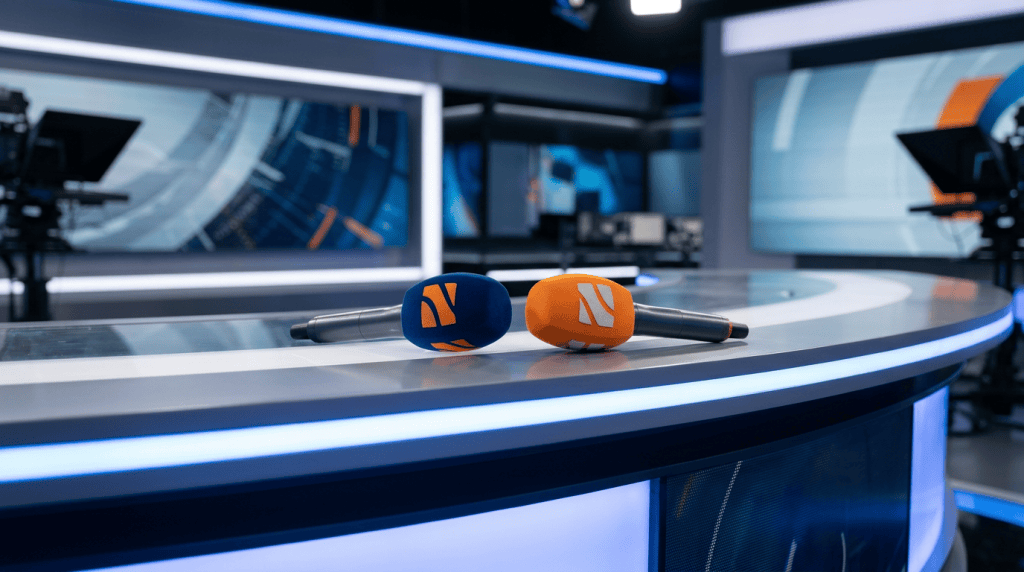
The shape and colour of the foam windscreen matter here. Windscreens in the station’s brand colours, or windscreens with printed logos, contribute actively to the on-screen identity of the programme.
3. Branding and visual identity
For broadcast organisations, a mic windscreen for broadcast is often a live, on-air branding surface. Every time a reporter appears on camera with a microphone, the windscreen is visible. Over the course of a news day, a sports broadcast or a live event, the windscreen appears hundreds of times across multiple camera angles.
Custom printed foam windscreens – featuring the station’s logo, name and brand colours – are used by professional broadcasters globally for this reason. The investment in branded windscreens is small relative to the on-air visibility they generate. It also ensures brand consistency: every reporter, regardless of location, carries the same visual identity.
This is one area where foam has no competition – fur windscreens cannot be meaningfully branded. For any broadcast organisation that cares about its visual identity (which is to say all of them), foam windscreens with custom branding are not optional kit. They are part of the broadcast package. For on-mic graphic branding, mic flags and cubes offer the largest printable area – see the mic flags and cubes range. Learn more about custom branded options at line-in.eu.
4. Fit and microphone compatibility
A mic windscreen for broadcast that does not fit correctly fails on multiple counts. A windscreen that is too loose moves on camera, risks falling off during a live take, and provides uneven wind protection. A windscreen that is too tight can be difficult to remove and may deform the foam over time, shortening its useful life.
Professional foam windscreens are manufactured to specific internal diameters that match common microphone models and grille dimensions. Ordering windscreens to the correct internal diameter for your specific microphone – whether that is a Sennheiser MD 42, a Shure SM58, a DPA 2028, or any other broadcast-standard model – is essential for operational reliability.
If you are sourcing windscreens for a fleet of mixed microphone models, check that your supplier can provide different sizes for different models, or that you are ordering model-specific versions rather than generic “universal fit” covers. For guidance on sizing, the line-in.eu product range includes windscreens for a range of standard broadcast mic shapes and sizes.
5. Durability and replacement cycle
A broadcast station’s microphone windscreens are in daily use. They are handled constantly, dropped, packed into bags, cleaned between uses, and exposed to varying conditions. The durability of the foam material – specifically its resistance to tearing, deformation and surface degradation – directly affects how long a windscreen remains usable.
Professional foam windscreens from established manufacturers maintain their shape and acoustic properties through many months of regular use. Cheap foam degrades quickly – tearing at the opening, flattening out, and losing the tight fit that keeps them on the mic. Factoring replacement cost and frequency into windscreen procurement is sensible for any station managing a fleet.
Windscreens that are regularly rebranded or updated (for a new season, a rebrand, a sponsorship) benefit from suppliers who can deliver consistent colour matching and print quality across repeat orders. Pantone-matched foam colours ensure visual consistency even across orders placed months apart. See Colour Matching Microphone Windshields for details on this process.
6. Wind protection for outdoor use
For reporters working outdoors in typical broadcast environments – street interviews, event coverage, outdoor press conferences – a quality foam windscreen for broadcast provides adequate wind protection in the majority of real conditions. Light to moderate wind is well within foam’s capability.
The foam windscreen’s limitation appears in sustained, strong outdoor wind. For boom microphones and camera-mounted shotgun mics used in exposed positions, supplementing with fur or a combination windscreen system is sensible. But for the on-camera handheld microphone, foam remains the right tool even outdoors, combined with good mic handling technique.
Practical Recommendations for Broadcast Stations
For a TV news station, a typical windscreen kit should include:
- Branded foam windscreens for all on-camera handheld microphones. Match the station’s colour palette and include the logo for maximum on-air branding value.
- Plain foam windscreens in neutral colours for studio and desk microphones where branding is not a priority.
- Spare stock of each size – windscreens do get lost and damaged during live operations.
- Camera-mounted shotgun windscreens for ENG cameras, sized for the specific shotgun models in use.
For a radio station, the priority is acoustic performance in studio – plain foam windscreens on all vocal microphones, sized correctly for each model.
For a sports broadcaster, consider the difference between commentary position microphones (studio-like, protected, foam is fine) and field/pitch-side microphones (potentially exposed, consider combination systems).
FAQ
What type of windscreen is used in broadcast TV studios?
Broadcast TV studios standardly use foam windscreens. Fur windscreens are not used in studio environments – they are unnecessary and aesthetically unsuitable for on-screen use.
Do I need a windscreen on a studio microphone?
Yes. Even in a controlled studio environment, foam windscreens protect against plosive consonants, light airflow from ventilation, and accidental physical contact with the microphone grille. They also present a professional appearance on camera.
Can a foam windscreen be branded with our station’s logo?
Yes. Custom foam windscreens can be manufactured in your brand colours and printed with your logo using UV or pad printing. This is standard practice for professional broadcasters.
How often should broadcast windscreens be replaced?
This depends on usage intensity and foam quality. In regular daily broadcast use, professional foam windscreens typically last many months before showing significant wear. Inspect regularly for tears, deformation or loss of tight fit.
What size windscreen does my microphone need?
Windscreen size is determined by the internal diameter and length of the mic’s grille section. Manufacturers publish these dimensions, or your windscreen supplier can advise. Correct fit is essential – too loose or too tight both cause problems in operation. For a full sizing walkthrough, see How to Choose Mic Windscreen Size: A Practical Sizing Guide.
For the full context on foam vs fur wind protection across all scenarios, refer to the main cluster guide: Foam vs Fur Windscreen: How to Choose the Right Wind Protection.